Story of the Avant Garde : Alfred Jarry, Guillaume Apollinaire, Henri Rousseau and Erik Satie
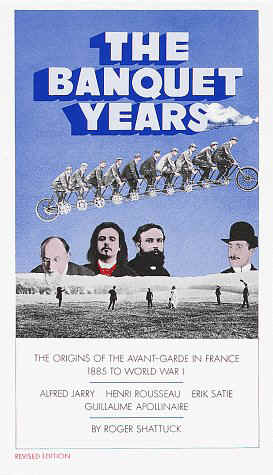
THE BANQUET YEARS BY ROGER SHATTUCK
This is one of several books which helped to create my obsession with this particular period in history and in the history
of Modern Art. Out of the traditional and stodgy and uninteresting past came an explosion of creativity and a freedom unknown
in the history of Western Art and literature which is felt to this day as if it were the long awaited Big-Bang . Afterwards
nothing was the same . Out of this period arose a thousand and one new artistic movements in painting, poetry , prose, fiction,
music, including the performing arts of drama, of dance , of performance art etc.
Excerpts from the wonderful and exceptional book :The Banquet Years: The Arts in France , 1885-1918, Alfred Jarry, Henri Rousseau,
Erik Satie Guillaume Apollinaire by by Roger Shattuck
New York Harcourt, Brace and Company, 1958.
ONE • The Good Old Days
The French call it la belle époque--the good old days. The thirty
years of peace, prosperity, and internal dissension which lie across 1900
wear a bright, almost blatant color. We feel a greater nostalgia looking back
that short distance than we do looking back twenty centuries to antiquity.
And there is reason. Those years are the lively childhood of our era; already
we see their gaiety and sadness transfigured.
For Paris they were the Banquet Years. The banquet had become the
supreme rite. The cultural capital of the world, which set fashions in dress,
the arts, and the pleasures of life, celebrated its vitality over a long table
laden with food and wine. Part of the secret of the period lies no deeper than
this surface aspect. Upper-class leisure--the result not of shorter working
hours but of no working hours at all for property holders--produced a life
of pompous display, frivolity, hypocrisy, cultivated taste, and relaxed morals.
The only barrier to rampant adultery was the whalebone corset; many an
errant wife, when she returned to face her waiting coachman, had to hide
under her coat the bundle of undergarments which her lover had not been
dexterous enough to lace back around her torso. Bourgeois meals reached
such proportions that an intermission had to be introduced in the form of a
sherbet course between the two fowl dishes. The untaxed rich lived in
shameless luxury and systematically brutalized le peuple with venal journal
ism, inspiring promises of progress and expanding empire, and cheap
absinthe.
Politics in la belle époque found a surprisingly stable balance be
tween corruption, passionate conviction, and low comedy. The handsome
and popular Prince of Wales neglected the attractions of London to spend
his evenings entertaining in Maxim's restaurant, and he did not entirely
change his ways upon becoming Edward VII. It was the era of gaslights
and horse-drawn omnibuses, of the Moulin Rouge and the Folies-Bergère,
of cordon-bleu cooking and demonstrating feminists. The waiters in Paris
cafés had the courage to strike for the right to grow beards; you were not a
man or a republican without one at the turn of the century. Artists sensed
that their generation promised both an end and a beginning. No other
equally brief period of history has seen the rise and fall of so many schools
and cliques and isms. Amid this turmoil, the fashionable salon declined
after a last abortive flourishing. The café came into its own, political unrest
encouraged innovation in the arts, and society squandered its last vestiges of
aristocracy. The twentieth century could not wait fifteen years for a round
number; it was born, yelling, in 1885.
It all started with a wake and funeral such as Paris had never
staged even for royalty. In May, 1885, four months after an immense state
banquet to celebrate his eighty-third birthday, Victor Hugo died. He left the
following will: "I give fifty thousand francs to the poor. I desire to be
carried to the cemetery in one of their hearses. I refuse the prayers of all
churches. I ask for a prayer from all living souls. I believe in God." Four
years earlier, during public celebrations of his eightieth year of vigor, the
Avenue d'Eylau, where he lived, had been officially renamed in his honor.
Now his remains lay in state for twenty-four hours on top of a mammoth
urn which filled the Arc de Triomphe and was guarded in half-hour shifts
by young children in Grecian vestments. As darkness approached, the festive
crowd could no longer contain itself. "The night of May 31, 1885, night
of vertiginous dreams, dissolute and pathetic, in which Paris was filled with
the aromas of its love for a relic. Perhaps the great city was trying to recover
its loss. . . . How many women gave themselves to lovers, to strangers,
with a burning fury to become mothers of immortals!" What the novelist
Barrès here describes (in a chapter of Les déracinés entitled "The Public
Virtue of a Corpse") happened publicly within a few yards of Hugo's
apotheosis. The endless procession across Paris the next day included several brass bands, every political and literary figure
of the day, speeches, numerous deaths in the press of the crowd, and final entombment in the Panthéon.The church had to be
specially unconsecrated for the occasion. By this orgiastic ceremony France unburdened itself of a man, a literary movement,
and a century.
FOUR · The Paintings- Henri Rousseau
They [the primitive painters of 1300-1500] had in common
a compact clear technique,
and a still awkward command of form, movement, and light,
although often more personal and moving than
that of their successors.
-- Charles Sterling, Les peintres primitifs
The initial question in dealing with Rousseau's work is immedi
ately thrust upon us: Is he a modern "primitive"? The terms "primitive"
and "naïf" were used very early to describe his work and found ready ac-
ceptance; recent estimates of his work have tended to treat him as a painter
who cannot be separated from the evolution of modern art by such glib and
arbitrary classifications. Almost fifty years after his death we may well
challenge the stock adjectives. Yet if its meaning is carefully restricted, the
term "primitive" can be applied to Rousseau without misrepresentation.
It is no slur to call Giotto and Cimabue "primitive"; it is a means of
locating them within two centuries which prepare the formulation of the
strict optical conventions of Renaissance art. Rousseau reveals a comparable
primitivism, for he strove in his conscious thinking about art to achieve a
naturalistic, academic style. He admired Bouguereau and Gérôme and Cour
tois. Twentieth-century Western art, however, the disgruntled offspring of a
great naturalistic tradition culminating in impressionism, was seeking out
the methods of primitives from Italy, Africa, and contemporary Paris. Like
Picasso and Braque and Matisse and Delaunay, Rousseau worked not with
the optical image (a rational transformation of what we see), but with his
personal beholding of things. He stood beside them without having made the
journey of styles which they had made in their development as artists. He is
primitive in that, occupying the same ground as these men, he nevertheless
looked yearningly toward a style they violently rejected. Robert Goldwater
writes of this paradoxical situation in a sentence that is not so muddled as
it seems.
But it is important to realize that the style which he achieved was but a stopping
place upon a road along which he would have travelled further if he could, and
that the effect which be attains, seen from the point of view of the mechanics and
-62-
SIX · Scandal, Boredom, and Closet Music- Erik Satie
Satie's career after 1910, his second coming, has frequently been
recounted, for it lies within the memory of many people who are still living.
The time came to "discover" his disconcerting genius, yet it was the same
personality whose antics had startled Montmartre twenty years earlier. The
century had taken its first steps. Fauvism and then cubism had replaced
impressionism as the artistic avant-garde; the principal figures of the "New
Spirit" in literature, Apollinaire and Jacob, were working in close touch
with painters; the Ballets Russes would soon shock Paris with the distinctly
fauve rhythms of Stravinsky Sacre du printemps; Debussy was attracting
disciples and imitators. It turned out that Satie himself had been changing
and could not be relied on to act as if he had been dead for twelve years.
His new works belied all preconceived ideas about his style. It was for these
pieces that Satie wrote the publisher's blurb (quoted on pages 88-89).
Not unlike Rousseau being feted by the cubists, Satie was "taken
up" in the years 1910-1912 by his old friends Ravel and Debussy. Since
these two composers were no longer on amicable terms, they appeared to
vie for the right to rediscover Monsieur le Pauvre, as Satie came to be
called. In January, 1911, at the recently formed Société indépendante
musicale (S.I.M.), sponsored by Fauré, Ravel performed three of Satie's
works composed more than twenty years earlier. The program spoke warmly
of "a prescience of the modernist vocabulary" and "the quasi-prophetic
character of certain harmonic discoveries." A few months later, at the
Cercle musical, Debussy conducted two Gymnopédies, which he had orches
trated in 1897. Roland-Manuel, who had been an enthusiastic young class
mate of Satie's at the Schola, orchestrated the prelude of La porte héroïque
du ciel ( 1894) for the S.I.M. in 1912. The critics Calvocoressi, Ecorche
ville, and others wrote increasingly sympathetic notices, and entire concerts
-113-
EIGHT · Poet and 'Pataphysician- Alfred Jarry
Jarry's death resembled nothing so much as a drowning.
"According to our observations," he wrote in Spéculations, "a drowned man
is not a person killed by submersion. He is a being apart." In the beginning
his memory left little trace, with Gémier giving one brief revival of Ubu Roi
in 1908 and a few posthumous works coming out almost unnoticed. Several
writers--Apollinaire, Salmon, Jacob, Cocteau, Breton, Artaud--never forgot
Jarry's example, but, without Jarry to do his own publicity, the time was not
ripe to bring him out of the depths. It was the repercussions of World War
I that began to jar him back to the surface in 1921-1922 during the height
of the Dadaist demonstrations. Two new volumes were issued (one of them
edited by the youthful André Malraux), and Charles Chassé published a
book violently contesting Jarry's authorship of Ubu Roi in favor of one
of the surviving Morin brothers, an artillery officer. Chassé as much as
accused Jarry of plagiarism and, to boot, challenged the literary merit of
the supposedly purloined text. The mixed outburst of protest and welcome
which greeted this attack resounded through every literary quarter, until the
critic Jean Epstein declared: "More ink has been spilled about whether or
not Jarry is the author of Ubu Roi than on investigating the question of
Naundorff's being the son of Louis XIV. M. Chassé's book touched off a
powder keg." The truth, however, had been clear all along. A play originally
written in collaboration had become Jarry's by default. His new title and
revisions made it indisputably his.
This lengthy debate, far from deflating Jarry's reputation, blew it up
to new greatness. Cocteau fantasy-novel Le Potomak ( 1919) had already
started mutterings about Jarry's influence on the younger generation. The
surrealists, setting up shop in 1924, named him one of their patron saints.
Three biographies appeared in rapid succession including Rachilde's. In
1926 in Les faux-monnayeurs, the only one of his books he was ever willing
-173-
Guillaume Apollinaire, 1880-1918
NINE · The Impresario of the Avant-Garde
I love men, not for what unites them,
but for what divides them,
and I want to know most of all
what gnaws at their hearts.
--Anecdotiques
In his thirty-eight years Guillaume Apollinaire contrived to
leave a lasting mark on the poetry and painting of the twentieth century.
Yet the welter of material that has appeared on his life and personality
makes a discouraging confusion out of his career. What one acquaintance
took for amiability and good humor, another took for fawning or deliberate
inconsistency. He excelled, in fact, in balancing natural charm against in
tentional outrage. The different sides of his temperament complemented each
other and produced an impression, unlike the one Jarry left, of evasiveness.
Many acquaintances wondered how much of him showed above the sur
face. He was not Bohemian in the sense of scorning recognized channels
of accomplishment. Yet there was in him a distinct gift for sustaining an
unusual form of conduct and speech, in the knowledge that it would be
noticed and remembered. Whereas Jarry by a tremendous tour de force
created his role and lived up to it, Apollinaire exploited his expansive per
sonality, celebrated it in his writing, and ran the constant risk of turning his
private life into a public performance. Jarry left himself behind for a fiction;
Apollinaire tried to carry everything along with him willy-nilly--fact and
legend, gossip and falsehood.
Barely turned twenty, Apollinaire put words of extravagant prophecy
into the mouth of Dr. Cornelius Hans Peter of Prague, a character in the
serial novel Que faire?
On my arrival on earth I found humanity on its last legs, devoted to fetishes,
bigoted, barely capable of distinguishing good from evil--and I shall leave it
intelligent, enlightened, regenerated, knowing there is neither good nor evil nor
God nor devil nor spirit nor matter in distinct separateness.
Ten years later, this hortatory, messianic tone had become his own, assert
ing itself in much of his poetry and more insistently in his critical writing.
-195-
TWELVE · The Last Banquet
When the avant-guerre ended in 1914 with the first hostilities
in Europe for almost half a century, the cultural capital of that prosperous
world seemed a different place from what it had been in 1885. It was not
merely that Paris was being equipped with electric lights, telephones, motor
buses, taxis, and elevators. It was not merely that the American bar, the
English tearoom, and the international music hall had established themselves
for good. Fashionable society, seeming to sense that things would never be
the same again, galloped through these last years in a paroxysm of activity.
It is best represented by the dazzling figure of Boni de Castellane, an indigent
marquis who married the American heiress Anna Gould. Their Pink Palace
on the Avenue du Bois, their sumptuous parties in the Bois itself, and his
injection of taste and refinement into the most extreme luxury made him the
hero of an expiring way of life. His memoirs chronicle the close of an era.
At the opposite end of the disintegrating social order one comes
upon a new domain, not of elegance but of the sporty proletarian truculence
spawned by the avant-garde. The aristocratic prestige of the arts, embodied
in Robert de Montesquiou's dandified behavior in the nineties, could no
longer resist the onslaught of a figure like Arthur Craven. This robust, tri
lingual nephew of Oscar Wilde was a professional boxer, traveling to title
bouts all over Europe until he switched to literature in 1911 at the age
of thirty and made his mark in Paris. He published a one-man magazine
called Maintenant, which he peddled from a wheelbarrow around sports
arenas and subway entrances. Handsome, unpredictable, photographed more
often in tights than fully clothed, Craven had an ebullience that carried
him into belligerent defiance of convention. In its systematic provocation, his
writing resembles a literary transposition of boxing techniques. He baited
Apollinaire into challenging him to a duel, insultingly interviewed Gide,
overturned every idol in his path, and fled conscription during the war to
-272-
MAX ERNST FROM SURREALIST & SURREALISM .Com Surrealist.com
(1891 - 1976)
Biography: Ernst studied philosophy at Bonn University, before being influenced by August Macke and taking up painting. In
1919, he and Johannes T. Baargeld founded the Cologne dadaist group. Together, they published the review Die Schammade, though
only one edition was published in 1920. In 1922, Ernst moved to Paris, where he became on of the founding fathers of surrealism.
He invented "frottage" in 1925, and this allowed for some of his most remarkable work. His greatest period began with the
paintings entitled Garden Aeroplane Trap (1935 – 1936), as well as the sequence of paintings including the Nymph Echo
and Joie de vivre (1936), produced using decalcomania. He continued this period in America between 1941 and 1953, with Antipope
(1942), Rhenish Night (1944), and The Eye of Silence (1945). Ernst remained true to the surrealist movement when he returned
to France. In 1954, he won the Grand Prix at the Venice Biennale. His traditional paintings, such as Messalina as a Child
and The Famous Dream-Smith (1959), while decent in artistic merit, are believed to be far less original than those created
in his surrealist period.
SURREALIST JOAN MIRO THE DREAM OF REVOLUTION EXPLORATIONS.COM EARTHBOUND ANGEL #5 SENUOUS ANGEL OR THE
ROSE OF SHARON
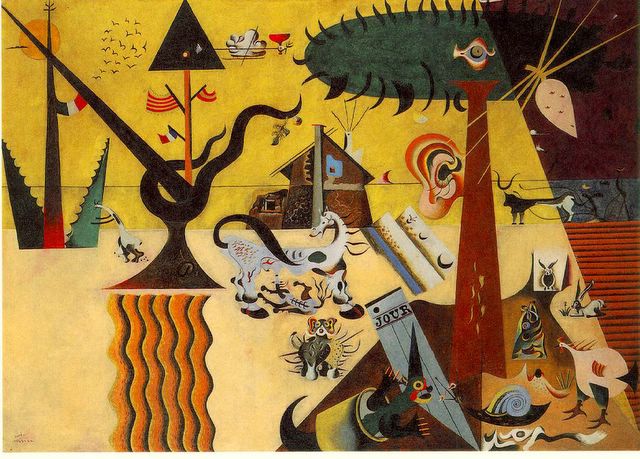
PAINTING BY JOAN MIRO(1893-1983)"TILLED
FIELD" Posted by Hello PAINTING BY MAX ERNST (1891-1976)
"CHILDREN MENACED BY A NIGHTINGALE" Posted by Hello PAINTING BY JOHN HENRY FUSELI
(1741-1825) " THE NIGHTMARE" Posted by Hello
On the subject of art history see website The Art Millennium:
The largest art encyclopedia on the internet. It contains more than 15000 pictures
and overviews of more than 1000 artists, collections, explorations... Explorations/ Modern Art SURREALISM & the Dream Of Revolution /www.nelepets.com/art/pictures/pictures_content
This site includes history of art from 1400-late 20th century from Apocalyptic Images & Arthurian Legends to Pop art etc.
Anyway here is a glimpse at the art of Spanish Surrealist Joan Miro:
“ Miró (1893-1983) drew on memory, fantasy, and the irrational to create works of art that are visual analogues of surrealist
poetry. These dreamlike visions, such as Harlequin's Carnival or Dutch Interior, often have a whimsical or humorous quality,
containing images of playfully distorted animal forms, twisted organic shapes, and odd geometric constructions.
Amorphous amoebic shapes alternate with sharply drawn lines, spots, and curlicues, all positioned on the canvas with seeming
nonchalance. Miró later produced highly generalized, ethereal works in which his organic forms and figures are reduced to
abstract spots, lines, and bursts of colors.”
See also OLGA’S GALLERY which is good comprehensive site on art history http://www.abcgallery.com/M/miro
And: Mark Harden’s Artchive “JOAN MIRO”
Another site to check out is: The Surrealists website www.surrealist.co.uk
ART:
SURREALISM:
Breton saw the unconscious
as the wellspring
of the imagination.
He ( BRETON ) defined genius in terms
of accessibility
to this normally untapped realm,
which,
he believed, could be attained
by poets
and painters alike.
Surrealism and Rene Magritte- oh sinner man
SURREALIST - TRISTAN TZARA :
Every page must explode, either by profound heavy seriousness, the whirlwind, poetic frenzy, the new, the eternal, the crushing
joke, enthusiasm for principles, or by the way in which it is printed. On the one hand a tottering world in flight, betrothed
to the glockenspiel of hell, on the other hand: new men. Rough, bouncing, riding on hiccups. Behind them a crippled world
and literary quacks with a mania for improvement.
I say unto you: there is no beginning and we do not tremble, we are not sentimental. We are a furious Wind, tearing the dirty
linen of clouds and prayers, preparing the great spectacle of disaster, fire, decomposition. We will put an end to mourning
and replace tears by sirens screeching from one continent to another. Pavilions of intense joy and widowers with the sadness
of poison.
Surreal Art- Persephone- Wishbone Ash
(art slide show - music: persephone - wishbone ash // art from "www.surrealartforum.com/artlinks.htm")
Chagall- Berlioz, fantasy on " The Tempest"
And here is a definition of Surrealism
which maybe completely & utterly unhelpful from Surrealist.com
Sur - re - al - ism (n.) -(often l.c.) a style of art
and literature developed principally in the
20th century, stressing the subconscious
or nonrational significance of imagery arrived at by automatism or the exploitation of
chance effects, unexpected juxtapositions, etc.
----------
Surrealism :
The surrealist movement of visual art and literature,
flourished in Europe between World Wars I and II.
Surrealism grew principally out of
the earlier Dada movement, which before
World War I produced works of
anti-art that deliberately defied reason;
but Surrealism's emphasis was not
on negation but on positive expression.
The movement represented a reaction against
what its members saw as
the destruction wrought by the "rationalism"
that had guided European culture
and politics in the past and
had culminated in the horrors of
World War I.
----- ------------------------------------------
According to the major spokesman of the movement,
poet and critic André Breton, who published
"The Surrealist Manifesto" in 1924,
Surrealism was a means of reuniting
conscious and unconscious realms
of experience so completely,
that the world of dream and fantasy
would be joined
to the everyday rational world
in "an absolute reality,
a surreality."
----------------------------------------------------
DALI
Dali a Bizarre bit of egotism- Dali & Gala born from an egg!!!
Disney/Dali
momentos ludicos Yerka -art work of Yerka set to music