|
" I love men, not for what unites them, but for what divides them, and I want to know most of all
what gnaws at their hearts. "
Guillaume Apollinaire
" A structure becomes architectural, and not sculptural, when its elements no longer have their justification in
nature."
Guillaume Apollinaire
" Artists are, above all, men who want to become inhuman."
Guillaume Apollinaire
Two Poems by Guillaume Apollinaire
- Hunting Horns -
Our past is as noble and as tragic
As the mask of a tyrant
No tale of danger or of magic
Nothing so insignificant
Describes the pathos of our love
And Thomas de Quincy drinking his
Sweet and chaste and poisoned glass
Dreaming went to see his Ann
Let us since all passes pass
I shall look back only too often
Memories are hunting horns
Whose sound dies among the wind
- Autumn Crocuses -
by Guillaume Apollinaire
The meadow is poisonous but pretty in the autumn
The cows that graze there are slowly poisoned
Meadow-saffron the colour of lilac and of shadows
Under the eyes grows there your eyes are like those flowers
Mauve as their shadows and mauve as this autumn
And for your eyes' sake my life is slowly poisoned
Children from school come with their commotion
Dressed in smocks and playing the mouth-organ
Picking autumn crocuses which are like their mothers
Daughters of their daughters and the colour of your eyelids
Which flutter like flowers in the mad breeze blown
The cowherd sings softly to himself all alone
While slow moving lowing the cows leave behind them
Forever this great meadow ill flowered by autumn
"Art is a fruit that grows in man, like
a fruit on a plant, or a child in its mother's womb." Hans Arp
"Soon silence will have passed into legend. Man has
turned his back on silence. Day after day he invents machines and devices that increase noise and distract humanity from the
essence of life, contemplation, meditation." Hans Arp

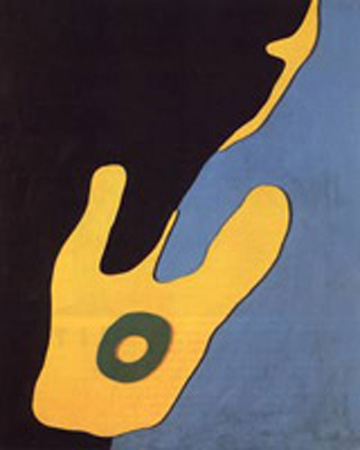
|  | 
HANS ARP (1886-1966)"
CONFIGURAZIONE # 1 "
Posted
by Hello

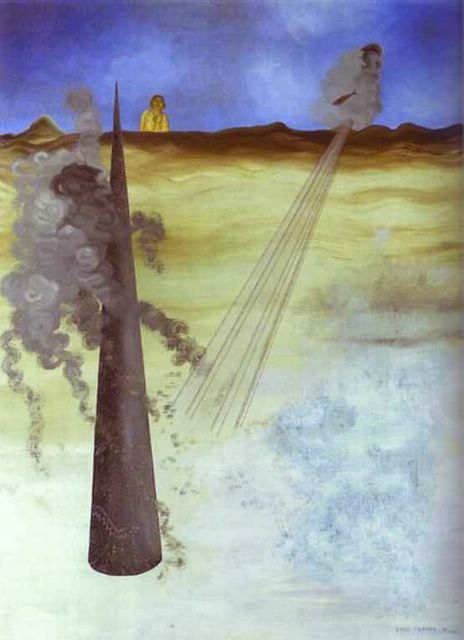
PAINTING BY SURREALIST
YVES TANGUY (1900-1955) "I CAME LIKE I PROMISED "
Posted by Hello

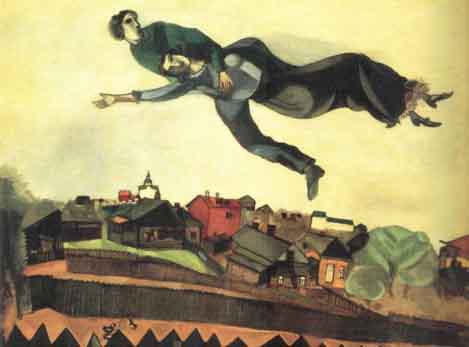
PAINTING BY MARC CHAGALL
(1887-1985)"ABOVE THE TOWN"
Posted by Hello

PAINTING BY MARC CHAGALL
(1887-1985) "CEMETERY GATES"
Posted by Hello
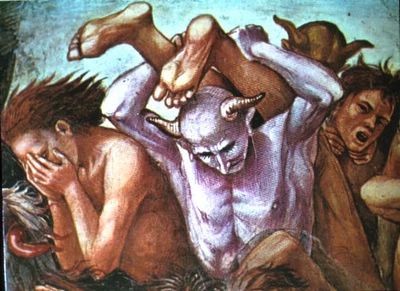
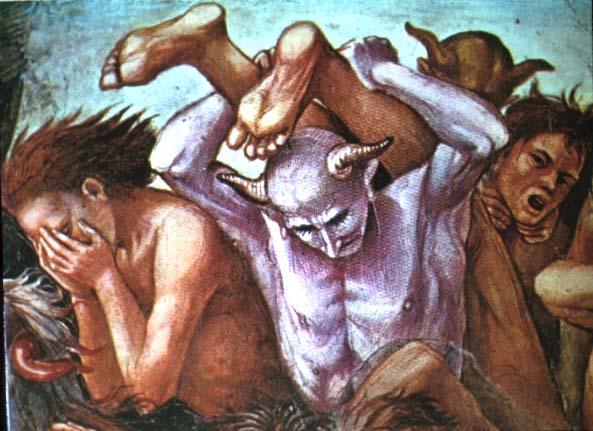
PAINTING BY SIGNORELLI
(1441-1523) " DEVIL DRAGGING SOULS TO HELL"
Posted by Hello
NOTE: In the four images above below the work by Hans Arp I have tried to give a representation of the experiences
& emotions of my piece of poetry below entitled " A DANSE MACABRE" . Let me know if you thought it worked or not.
And
now a few words about DADAIST & Surrealist Xtror_ dinaire :
Hans/Jean Arp (1886-1966)
French sculptor, painter,
collagist, printmaker and poet of German birth. The son of a German father and French Alsatian mother, he developed a cosmopolitan
outlook from an early age and as a mature artist maintained close contact with the avant-garde throughout Europe.
He was
a pioneer of abstract art and one of the founders of Dada in Zurich, but he also participated actively in both Surrealism
and Constructivism. While he prefigured junk art and the Fluxus movement in his incorporation of waste material, it was through
his investigation of biomorphism and of chance and accident that he proved especially influential on later 20th-century art
in liberating unconscious creative forces.
Definitions:
Biomorphism:
Term derived from the Classical concept
of forms created by the power of natural life, applied to the use of organic shapes in 20th-century art, particularly within
SURREALISM. It was first used in this sense by Alfred H. Barr jr in 1936. The tendency to favour ambiguous and organic shapes
in apparent movement, with hints of the shapeless and vaguely spherical forms of germs, amoebas and embryos, can be traced
to the plant morphology of Art Nouveau at the end of the 19th century; the works of Henry Van de Velde, Victor Horta and Hector
Guimard are particularly important in this respect.
Fluxus:
Name of a group or movement, from the Latin for 'a flowing',
formed in Germany in 1962 by the Lithuanian-born American theorist and art philosopher George Maciunas (1931-1978). He wished
to instigate an anti-art, anti-bourgeois pro-gramme involving and mingling several art forms and operating mostly outside
the world of art commerce. In spirit, therefore,
Fluxus came close to a revival of Dada, though its work was seldom as
openly political as some of the Dadaists were. What it presented, during about ten years of notable activity, was often in
the form of Happenings, as in street events; it gave some per-manence to its doings through publications. Many American artists
played some part in Fluxus, but its main arena was Germany where Beuys and Vostell were involved for a time.
Definitions
provided by:
www.nelepets.com/art/20c/terms,group/biomorphism
Arp’s
poetry has a beautifully haunting quality to it & his poetry seems deceptively simple yet pure.
So here is a sample
of his poetry.
The Plain by Jean (Hans) Arp
I was alone
with a chair on a plain
Which lost itself in an empty horizon.
The plain was flawlessly paved.
Nothing, absolutely
nothing but the chair and I
were there.
The sky was forever blue,
No sun gave life to it.
An inscrutable,
insensible light
illuminated the infinite plain.
To me this eternal day seemed to be projected --
artificially--
from a different sphere.
I was never sleepy nor hungry nor thirsty,
never hot nor cold.
Time was only an
abstruse ghost
since nothing happened or changed.
In me Time still lived a little
This, mainly, thanks to the
chair.
Because of my occupation with it
I did not completely
lose my sense of the past.
Now and then I'd
hitch myself, as if I were a horse, to the chair
and trot around with it,
sometimes in circles,
and sometimes straight
ahead.
I assume that I succeeded.
Whether I really succeeded I do not know
Since there was nothing in space
By
which I could have checked my movements.
As I sat on the chair I pondered sadly, but not desperately,
Why the core
of the world exuded such black light.
For more examples of Hans Arp’s poetry seeOLDPOETRY.COM
& PoemHunter.com
See: Mark Harden’s Artchive: DADA AND SURREALISM
www.artchive.com/
& Surrealist.com
391:dada
www.391.org/dada.
And:
www.artic.edu/reynolds/essays/hofmann
theArt Institute of Chicago-Ryerson & Burnham Libraries
/www.geocities.com/
The Politics of Surrealism.
/www.freshwidow.com/
|
|
Surrealist Poet Hans Arp
| | Example of Poetry of HANS ARP 1887-1966
The
Domestic Stones (fragment)
The feet of morning the feet of noon and the feet of evening walk ceaselessly round
pickled buttocks on the other hand the feet of midnight remain motionless in their echo-woven baskets
consequently
the lion is a diamond
on the sofas made of bread
are seated the dressed and the undressed
the undressed hold leaden swallows between their toes
the
dressed hold leaden nests between their fingers
at all hours the undressed get dressed again
and the dressed
get undressed
and exchange the leaden swallows .for the leaden nests
consequently the tail is an umbrella
a
mouth opens within another mouth
and within this mouth another mouth
and within this mouth another mouth
and
so on without end
it is a sad perspective
which adds an I-don't-know-what
to another I-don't-know-what
consequently
the grasshopper is a column
the pianos with heads and tails
place pianos with heads and tails
on their
heads and their tails
consequently the tongue is a chair ...
And here is another poem by Hans Arp
Kaspar Is Dead (Translated by G P Skratz)
o god our kaspar is dead
&
now there's no-one to steal away with the burning flag &
snap it every day in the dark cloud's braided hair.
no-one
to crank the coffee-mill in the ancient cask.
no-one to conjure idyllic deer from the petrified grocery bag.
no-one
to sniff ships umbrellas bee-keepers udders of wind
spindles of ozone no-one to filet the pyramids.
o god god god
our good old kaspar is dead. lord lord
kaspar is dead.
heart-broken shark's teeth rattle with grief in the belfry
when
we utter his given name. so i stick to his last,
sighing kaspar kaspar kaspar.
why have you deserted us. what form
has your great soul
wandered into now. have you become a star or a chain of
water on a hot whirlwind or a plump breast
of black light
or a transparent brick on the groaning drum of the rocks
of existence...
o now the crowns of our
heads the soles of our feet wither
away & angels smolder on the funeral pyre.
the dark bowling alley thunders
behind the sun & there's
no-one to wind the compasses & the wheels of wheelbarrows.
no-one to dine with
the phosphorescent rat at the barefoot
table.
no-one to drive off the wind devil when he tries to seduce
the horses.
no-one to teach us monograms
in the stars.
his bust will adorn all truly noble firesides but there is
no snuff & comfort for a dead head.
by
Jean Hans Arp
|
|
So here's a bit about Dada , Hans Arp & Hugo Ball etc.
Reinhard Döhl | Hans Arp and Zurich Dada
[Translated from the German by Roy F. Allen (and the author)]
Arp saw Dada above all as a new artistic attitude. His participation in the Dada demonstration and blagues in the Cabaret
Voltaire suggests that this new attitude also had for him a social, or, more precisely, an antisocial, antipolitical aspect:
Disgusted by the slaughter of the World War in 1914, we dedicated ourselves to the fine arts in Zurich. While in the distance
the thunder of the cannons rumbled, we sang, painted, glued, wrote with all our strength. We were looking for an elemental
art which would heal people of the madness of the times and a new order which would restore the balance between heaven and
hell.
Elsewhere he wrote:
Madness and murder were competing with each other as Dada was born of primeval sources in Zurich in 1916. The people who
were not directly involved in the horrible insanity of the World War acted as though they didn’t understand what was
taking place all around them. They stared into space with glassy eyes like lost lambs. Dada sought to wake them up from their
pitiful impotence. Dada abhorred resignation.
Arp’s role in Zurich Dada is characterised rather precisely by the fact that he painted, glued, and wrote "with all
the strength of his heart" in this political and social situation instead of becoming politically involved, as later did,
in particular, the Berlin Dadas. He opposed the "insanity" of the times with the "senselessness" of art. He searched for
and found an "elemental" art and tried to establish a "new order", a concept that for him meant first and foremost a new aesthetic
order.
What he calls "elemental" art here he later called "concrete" or at times also "abstract" art. "Abstract art (which Hans Arp
unswervingly advocates)," Ball noted on 13 April 1916, in his diary, which provides insight into Arp’s artistic views
and aims:
Arp speaks out against the bombast of the gods of painting (the expressionists). He says Marc’s bulls are too fat;
Baumann’s and Meidner’s cosmogonies and mad fixed stars remind him of the stars of Bölsche and Carus. He would
like to see things more ordered and less capricious, less brimming with colour and poetry. He recommends plane geometry rather
than painted versions of the Creation and the Apocalypse. When he advocates the primitive, he means the first abstract sketch
that is aware of complexities but avoids them. Sentiment must go, and so must analysis when it occurs only on the canvas itself.
A love of the circle and the cube, of sharply intersected lines. He is in favour of the use of unequivocal (preferably printed)
colours (bright paper and fabric); and he is especially in favour of the inclusion of mechanical exactness. I think he likes
Kant and Prussia because (in the exercise yard and logic) they are in favour of the geometrical division of spaces. In any
case, he likes the Middle Ages mostly for their heraldry, which is fantastic and yet precise and exists in its entirety, right
to the last really prominent contour. If I understand him correctly, he is not concerned so much with richness as with simplification.
Art must not scorn the things that it can take from Americanism and assimilate into its principles; otherwise it will be left
behind in sentimental romanticism. Creation for him means separating himself from the vague and the nebulous. He wants to
purify imagination and to concentrate on opening up not so much its store of images but what those images are made of. He
assumes here that the images of the imagination are already composites. The artist who works from his freewheeling imagination
is deluding himself about originality. He is using a material that is already formed and so is undertaking only to elaborate
on it."
Taeuber’s work in particular had a decisive influence on Arp’s artistic development after 1915. "She is led in
her first abstract compositions to the greatest degree of simplification" by her search "for new solutions to the problems
in art", by "her spiritual purity and her love of craftsmanship." Arp and Taeuber subsequently worked together a lot on horizontal
and vertical images, glued works, on many other projects:
Working together or alone, we embroidered, wove, painted, glued geometric and static pictures. Impersonal, austere structures
were created out of planes and colours. No blotches, tears, no fibres, no inexactitudes were to spoil the clarity of our work.
We even threw away the scissors with which we had first cut out our paper images because they too clearly revealed the personal
involvement of the hand. After that we used a paper cutting machine. We tried humbly to get as close as possible to ‚pure
reality‘. What we practised was the art of tranquillity. We turned away from the outer world of rapid-paced lives to
our inner being, to inner reality, to pure reality. [...] our work aimed at simplifying, transforming, beautifying. [...]
I continued the development of glued works by structuring them spontaneously, automatically. I called this working 'according
to the law of chance.' The 'law of chance', which incorporates all laws and is as inscrutable to us as is the abyss from which
all life comes, can only be experienced by surrendering completely to the unconscious. I claimed that, whoever follows this
law, will create pure life.
A final quotation will conclude this excursus on Arp’s statements about his development as an artist during the Zurich
period and will at the same time make clear how he evaluated this period himself.
"The years during which we worked exclusively on paper and cloth pictures, embroidery work, with new materials and in
which we avoided oil painting had a cleansing effect on us; they were like intellectual exercises to help us finally understand
painting in its original pure state."
For Arp thus, the "tortuous period" came to an end in his Dada years in Zurich; in this period he concluded his attempts to
free himself from the "inculcated, traditional forms of art" and achieved a new understanding of the fine arts, encountered
the problems that were to reappear again and again in his work for the rest of his life.
Arp’s attempts to " overcome the inculcated, traditional forms of art" should be understood not only as opposition to
"academic painting" that depicts " illusion instead of life and nature"; it can also be seen as a fundamental attempt to free
himself from an inculcated, conventional notion of art, from traditional conceptions of art all together. This is characteristic
of Arp’s work in both the fine arts and in literature. Before I turn to his literary development then, I will summarise
my findings thus far.
What Arp wanted was an elemental, or, as he later called it, a concrete art. To be able to produce it, he gave up traditional
approaches to representation, gave up traditional oil painting. He created images out of materials that until then were scarcely
considered customary, such as paper, cloth, wood, instead of paint. He employed unusual techniques or invented new ones: gluing,
tearing, cutting up. He rejected the traditional contents of images by simplifying drawings of twigs, roots, grasses, or stones
into "dynamic ovals" or by creating geometric constellations from the very start out of planes and colours. The artistic aim
of this work, which he repeatedly stressed in retrospective commentary, was purity, impersonality, simplicity. The work of
art was no longer to have any relationship with a depictable external reality and its objects. He discovered in these experiments
the "law of chance".
In particular, using words to achieve captivating effects, "doing away with sentences for the sake of the individual word,"
and then doing away with the word as well were to become an essential language experience of the Dadas. All of this had, of
course, been anticipated again by Italian futurism.
...Ball records in his diary Die Flucht aus der Zeit:
We have now driven the plasticity of the word to the point where it can scarcely be equaled. [...] We tried to give the
isolated vocables the fullness of an oath, the glow of a star. And curiously enough, the magically inspired vocables conceived
and gave birth to a new sentence that was not limited and confined by any conventional meaning. Touching lightly on a hundred
ideas at the same time without naming them, this sentence made it possible to hear the innately playful, but hidden, irrational
character of the listener; it awakened and strengthened the lowest strata of memory. Our experiments touched on areas of philosophy
and of life that our environment – so rational and precocious – scarcely let us dream of. (21)
Arp did not go quite so far in his justification of his literary work during his actual Dada years in Zurich, that is, after
1916:
Words, slogans, sentences, which were selected from daily newspapers and especially from advertisements in them, formed
the basis of my poems in 1917. I often selected words and sentences from newspapers with my eyes closed by marking them with
a pencil. I called these poems "arpades". It was the beautiful "period of Dada" in which we hated and ridiculed with all our
hearts the enchasing of our work, the confused looks of wrestlers of the intellect, the titans. I interwove the words and
sentences selected from the newspapers with freely improvised words and sentences of my own. Life is a mysterious breath of
air, and the result of it can be nothing more than a mysterious breath of air. I wrote a number of "arpades", which, however,
as was fitting, quickly vanished, disappeared. We wanted to look through things and see the essence of life, and that is why
we were moved at least as much by a sentence from a newspaper as by one written by a great poet.
...Arp added an instructive preface to a 1957 reprint of his simultaneous texts, Die Geburt des Dada, which included, as well,
some poems never published before:
The Odeon Café in Zurich became Dada’s Mecca and Medina. The numbers of Dadaists became so large that whoever wanted
to have a sensitive exchange of ideas had to find a quieter place. Since Tzara, Serner, and I wanted to compose automatic
poetry cooperatively, we met in the Terrace Café. I wrote about this poetry in my book Unsern täglichen Traum the following:
'Tzara, Serner, and I wrote a cycle of poems in the Terrace Café, entitled Die Hyperbel vom Krokodilcoiffeur und dem Spazierstock.
This kind of poetry was later christened ‚automatic poetry‘ by the Surrealists. Automatic poetry is created directly
from the intestines or other organs of the poet which have stored suitable reserves. He was to be hindered neither by Lonjumeau’s
postilion nor the hexameter, neither by grammar nor aesthetics, by Buddha nor the sixth commandment. The poet crows, curses,
sighs, stutters, yodels, as he sees fit. His poems resemble nature. The things which people like to call trivial are as precious
to him as noble rhetoric, for in nature a particle is as beautiful and important as a star, and it is only people who presume
to decide what is beautiful or ugly.' (24)
The same year Arp wrote texts by himself that are "related to automatic poems":
Many poems in die wolkenpumpe are related to automatic poems. They were written down, like the Surrealistic automatic
poems, uninhibitedly without thinking or revision. Dialect constructions, ancient sounds, vulgar Latin, confusing onomatopoetic
words and verbal spasms are particularly noticeable in these poems. The "cloud pumps" are, however, not only automatic poems,
but already anticipate my "papiers déchirés", my "torn pictures", in which "reality" and "chance" can be developed uninhibitedly.
The essence of life and decay is incorporated into the picture by tearing the paper or drawing. The same intent produced the
"cloud pumps" in 1917. I wrote these poems in a script that is difficult to decipher so that the printer would be forced to
use his imagination, and in deciphering my text, participate poetically. This collective work was very successful. Horny verbal
forms and distortions resulted which moved and affected my at that time. How many medieval copiers of manuscripts, I said
to myself, will have contributed some deep thought to their work out of misinterpretation or inattentiveness! How much immortal
beauty is the result of the further development of a falsely interpreted art form! My attitude is slightly different today.
ON DADA AND HANS ARP:
Dada and Dadaism: Dadart.com
Artlex.com Dada
Tout-Fait:Marcel Duchamp Studies Online Journal
UBUWEB
|