PHOTO ABOVE :LEONARD COHEN
Anyway I've been playing around with
windows movie maker & so here is a slide-show of the works of the great surrealist Frida Kahlo in a collage or montage
set to one of my favourite Leonard Cohen's songs " Heart with no companion " does it fit sort of or barely but probably a
perfect fit in this " best of all possible worlds " or worst of all possible worlds if the universe is just down right perverse...
" ZAPATISTA " BY DIEGO RIVERA

La
Llorona *Chorus*
Everyone calls me the dark one, Llorona
Dark but loving
I am like the green chile, Llorona
Spicy,
but tasty
They say that I do not feel pain Llorona
Because they don't see me cry
There are dead people who do
not make a sound, Llorona
And it is greater than their worry
Ah me, Llorona
Llorona of yesterday and today
Yesterday
I was a marvel Llorona
Today, I am less than a shadow of that
Ah me, Llorona
Llorona of the blue sky...
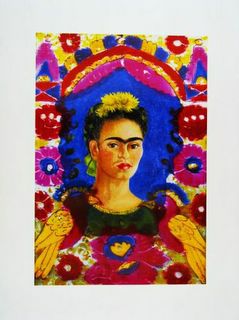
PAINTING BY FRIDA KAHLO
(1907-1954) " SELF-PORTRAIT" 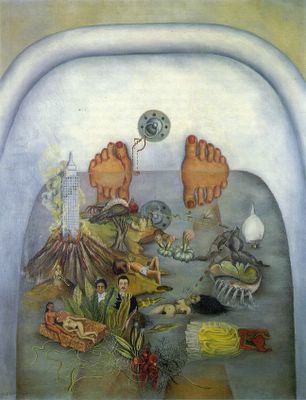
Above PAINTING BY FRIDA
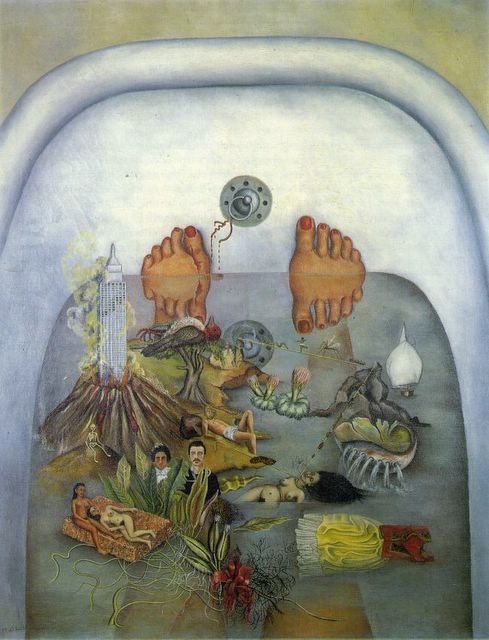
KAHLO 1938 " WHAT THE WATER GAVE ME"
PAINTING BY FRIDA KAHLO " KAHLODEER" Posted by Hello
The following bits
are from the website THE WORLD OF FRIDA KAHLO -
"Mourners gathered on July
13, 1954 to watch the cremation of the world's greatest and most shocking painter. Soon to be an international icon, Frida
Kahlo knew how to give her fans one last frightening goodbye. As the cries of her admirers filled the room, the sudden blast
of heat from the open incinerator doors blew her body bolt upright. Her hair, now on fire from the flames, blazed around her
head like a halo. Frida's lips appeared to break into a seductive grin just as the doors closed shut. Her last diary entry
read "I hope the leaving is joyful and I hope never to return". Frida was only 47 on the day she died. Her amazing, and many
times bloody self-portrait paintings will live forever..."
QUOTES Of FRIDA
KAHLO:
"I never knew I was a surrealist till Andre Breton came to Mexico and told
me I was."
"I paint my own reality. The only thing I know is that I paint because
I need to, and I paint whatever passes through my head without any other consideration."
"I suffered two grave accidents in my life. One in which a streetcar knocked me down.....The other accident is Diego."
"I drank to drown my pain, but
the damned pain learned how to swim, and now I am overwhelmed by this decent and good behavior."
Frida Kahlo holding Diego Rievera
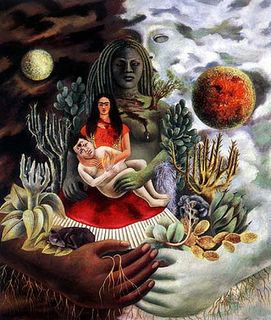
The painting above by Frida Kahlo is so surreal in the way it combines the different
images & iconography. Frida is holding Diego Rievera as in Modonna with child but they are being cradled by the Mother
Goddess -
In a fine article in the August 31, 2002 edition of The Village Voice, Joy Press provides the following
commentary about Kahlo: "Frida Kahlo was the perfect feminist heroine for the '80s. Hayden Herrera's Frida, the first biography
of the then obscure Mexican artist, was published in 1983, just as Madonna and Cindy Sherman were parlaying experiments with
female self-representation into a mainstream spectacle. At the same moment, interest in Latin American magic realism was booming,
and Kahlo's audacious, fantastical self-portraits placed her at the intersection of these otherwise unrelated trends.
Kahlo,
who died in 1954, was a crippled, bisexual Communist who painted visceral images of miscarriage and menstruation and was overshadowed
by her more famous husband, Diego Rivera. Yet in the last 20 years, she's joined the rarefied ranks of artists like Picasso,
whose work is as ubiquitous as wallpaper. More than just a poster girl for artsy adolescents or a Latina role model, Kahlo
is now a coffee mug, a key chain, and a postage stamp. Suddenly a fierce new wave of Fridamania is upon us that is conjuring
up a new Kahlo, customized to suit 21st-century desires. This spring brings the publication of Kate Braverman's The Incantation
of Frida K., a provocative novel based on her life, and the opening of "Frida Kahlo, Diego Rivera, and 20th Century Art,"
an exhibition at El Museo del Barrio featuring 10 of her paintings.
... Her life was also crammed with movie-ready
melodrama and tragedy. There's the trolley accident that shattered her teenage spine and sent a handrail through her pelvis,
leaving her unable to bear children; the tempestuous marriage to Rivera, a world-famous artist and compulsive adulterer; her
own numerous affairs, most notoriously with Leon Trotsky. Frida translated this raw material into paintings that pulse with
voluptuous agony and eccentricity
....Frida was once celebrated as the queen of pain. But now that female misery is unfashionable
(kicked out the door with so-called 'victim feminism'), the current resurrection of Frida Kahlo seems like a reaction against
the blandness of post-feminism...."
In his catalogue essay, "Frida and Diego," Gregory O'Brien, curator of the City Gallery
in Wellington, Australia, provides the following commentary" "While Rivera was painting massive murals depicting the heroic
struggle of Mexican society to fore its own future, Kahlo was staring into a mirror, descending into the depths of her own
being. Rivera's mission was, in his own words, to 'reproduce the pure basic images of my land. I wanted my paintings to reflect
the social life of Mexico as I saw it, and through my vision of the truth to show the masses the outline of the future.'
By contrast,
Kahlo singlemindedly explored the female condition in a series of self-portraits that revealed the tragedy of her medical
history and affirmed her Mexican identiy. She was also, as Rivera said, 'the first woman in the history of art to treat, with
absolute and uncompromising honesty, one might even say with impassive cruelty, those general and specific themes which exclusively
affect women.' Born in Coyoacán, Mexico, on 6 July 1907, Frida Kahlo was involved in a road accident at the age of eighteen
that would affect the rest of her life. The bus she was traveling on was hit by a tram and she was impaled on a piece of metal
- 'the arms of the seat went through me like a sword into a bull,' she recalled. Kahlo was plucked barely alive from the wreckage
and rushed to hospital. With her sister at her bedside and her family grief-stricken, Kahlo lay on her back in a plaster cast,
her spinal column broken in three places, and with a fractured pelvis and numerous broken bones. Kahlo's injuries left her
unable to have children and were the cause of grave ill health thoughout her life.
Bedridden
for some months, Kahlo abandoned plans of becoming a doctor - her intention since childhood - and began painting....It was
three years after her accident that she met Diego Rivera.
Diego Rivera was born in Guanajuato on 8 December 1886 and studied at the Academy of San
Carlos before travelling to Spain. He spent fourteen months in Europe, when he mixed with the cubists...attending in particular
to Puvis de Chavannes and the symbolists. In 1921, in the wake of the Mexican revolution, he returned home and became the
central figure in the mural movement. Turning his back on early experimental works such as The Last Hour, Rivera produced
an epic series of murals during the 1920s and 1930s - a period which is generally considered the apex of his career.
An
ardent communist, Rivera travelled to the Soviet Union in 1927. During the following year, while Rivera was painting murals
in the Ministry of Public Education, an admiring young woman seeking the elder artist's opinion of her work approached him.
Kahko was twenty-one at the time and Rivera forty-one. She became his third wife on 21 August 1929. On their first meeting,
Rivera immediately recognized the power of Kahlo's paintings: 'They communicated a vital sensuality, complemented by a merciless
yet sensitive power of observation. It was obvious to me that this girl was an authentic artist,' he said. As well as sharing
political convictions - both were members of the Communist Party - Kahl and Rivera had many artistic interest in common.
Both
were inspired by the primitivism of Rousseau and Gauguin and, most importantly, by Mexican folk art and pre-Hispanic culture.
Key figures in the Mexican cultural renaissance of the 1930s, Kahlo and Rivera were acutely aware of the significance of their
historical moment. Although adopting some of the contemporary modernist art conventions, both were concerned with pictorialising
such enduring themes as birth and death, fertility and barrenness.
Although their individual styles were
radically different, both were captivated by painting's potential explore the human condition. During the 1930s, the couple
travelled the world, spending four years in the United States, where Rivera worked on murals in San Francisco, Detroit and
New York.
During this time Kahlo had to have her first pregnancy terminated as a result
of a 'pelvic malformation.' A devastating series of miscarriages affected Kahlo's health, which was at best precarious and,
following an operation in 1934, she had several toes amputated....Serious strains were emerging in the couple's marriage,
with Rivera having embarked upon an affair with Frida's younger sister, Cristina....By the following year, Kahlo had moved
into an apartment of her own and regained her composure sufficiently to embark on an affair with the sculptor Isamu Noguchi.
Kahlo
and Rivera later resurrected their marriage, and Kahlo forgave her sister, who subsequently become, with her two sons, an
integral part of the unorthodox Rivera-Kahlo family.
...In 1938 Kahlo and Rivera travelled to Michoacán with the exiled Russian Leon
Trotsky (with whom Kahlo, famously, had an affair) and the leader of the French surrealists, André Breton, who immediately
claimed Kahlo as a 'surrealist' despite her claiming to have no knowledge of the movement....
...In
1943 Kahlo's work was exhibited in group shows in Mexico, Philadelphia and New York. Her paintings of that year attest to
her maturity and growing eloquence as a painter. Diego on my mind and Self-portrait with monkeys are tough-minded revisions
of the passive female subjects of western art history. Kahlo portrays herself as the master of her environment, both subject
and object of the painting - the centre of her own universe. Yet the paintings have their dark side: anxiety and vulnerability
persist. Although Kahlo's companions in Self-portrait with monkeys are traditional symbols of fertility and maternal protection,
the paintings can also be read as a study in childlessness and longing. Diego on my mind is a remarkable exploration of both
entrapment and fertility; of devotion and its dark cousin, obsession..
...In 1943, Rivera produced some of his most sumptuous reveries, among them such
lavishly constructed works as Sunflowers, Calla lily vendor and Portrait of Mrs. Natasha Gelman (whom Kahlo also painted that
year)."
Other films dealing with artists & writers I would suggest are :
Basquait,
Jackson Pollack, Henry & June, Kafka, Lust For Life, VINCENT, Camille Claudel, The Agony & the Ecstasy, Moulon Rouge
(the life of Toulouse Lautrec) &MOULON ROUGE the musical which is filled with surreal images & the use of contemporary
music in the 1885 setting ie Madonnas Like a Virgin etc. the film is a feast for the eyes & is funny touching & bizarre.

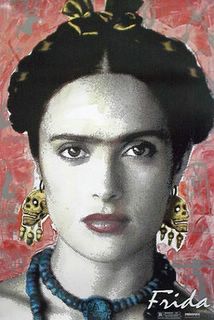
Salma Hayek as Frida Posted by Hello
Film review: FRIDA
Anyway I was watching the film FRIDA for the sixth or seventh time & I
wanted to encourage anyone interested in film or in the lives of artists or in feminist themes to see this film as it is a
must see . The film Frida was directed by Julie Taymor & stars Salma Hayek as Frida. It is the story of the life of the
Mexican artist Frida Kahlo who is now accepted as one of the greatest & most influential artists of the twentieth century.
Her work is filled with pain & beauty & with realism combined with primitivism & the fantastic & the grotesque
creating her own unique style. As a film biography it is a delightful surprise.
I had read biographies of Frida Kahlo & Diego Rievera about a dozen
or so years ago when I was going through my art history period so I was a little apprehensive about seeing this film as most
bio-pics are often disappointing. I had been greatly impressed & inspired by their lives which they dedicated to art &
the pursuit of their own artistic vision.Though no doubt this has coloured my viewing of the film to some extent either positive
or negative. I had also during that period read a great deal on modern art & on the various individuals movements &
techniques especially from Post-Impressionis & Expressionism to Dada & Surrealism & the dozens of movements in
between which led me to the writing of my epic-style poem Tales of Cafe Apollinaire. Since I couldn't paint or make a film
I made a poem.
Frida
spent most of her life in extreme physical pain due to a bus accident when she was seventeen which left her crippled &
she was not expected to ever walk again. But because of her stubborness & determination she refuses to give up. She doesn't
just walk again but becomes a strong & graceful dancer which is the focus of several scenes in the film as is her ability
to drink whiskey & tequilla as much if not more than most men & to even to land a good punch & hold her own in
a bar-room brawl .
Frida meets the great Mexican artist Diego Rievera who becomes her mentor & her greatest supporter.
Frida's life with him is one of great passion but it was also a rather stormy relationship. Frida eventually gots involved
in some scandalous affairs with men & women & even has an affair with the Russian revolutionary Leon Trotsky .
Frida's life seems more of a fantastic work of fiction rather than the
life of a real person because it was such an extraordinary life that she lived.
The contrast between the two artists is quite extraordinary in itself.
While Frida painted mostly on canvass small intimate & personal works of art Diego Rievera painted large sweeping murals
about the big subjects like history & politics & the class struggle etc. It was mainly due to Rievera along with Marc
Chagall that there was a revival of mural painting.
As for the film the cinematography is lush & vibrant like Fridas paintings
. There are scenes where painting & reality converge. The film also uses the modern techniques of collage & montage
to advance the story which also helps the viewer see the works of Frida Kahlo in the context of the great changes that were
on going in the arts of that period. The musical score is absolutely wonderful.
For more on Frida Kahlo see website
WORLD OF FRIDA KAHLO : members.aol.com/fridanet/kahlo & a dozen other sites.